Heat Rules: a work/rest planner for people working in extreme heat
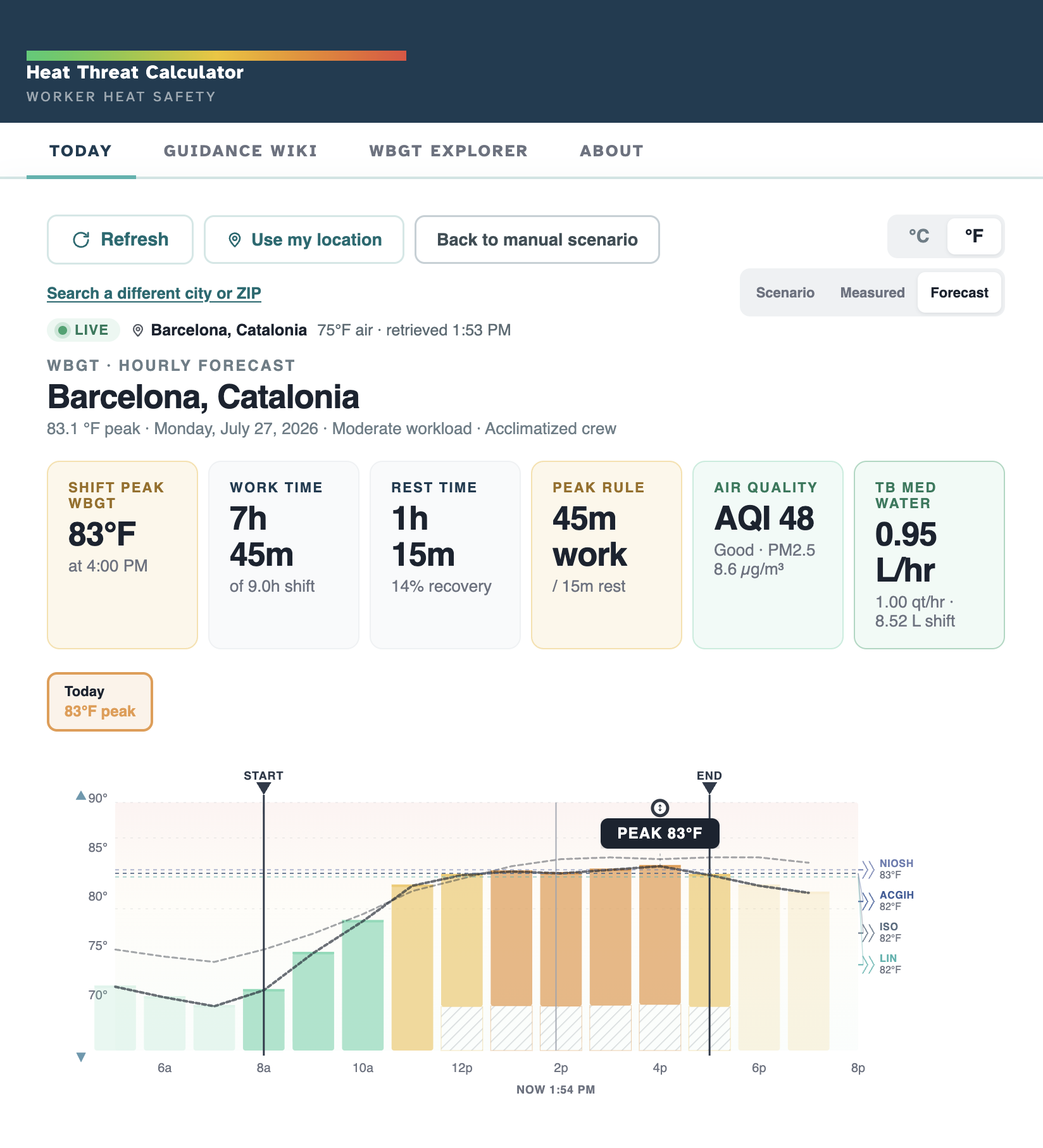
I’ve been exploring the world of heat stress for a few months with the team at La Isla Network and started building a simple tool to show recommended work/rest ratios based on the current wet bulb temperature. Large occupational health organizations like ACGIH, NIOSH, and ISO have published work/rest tables that work site managers should follow but it’s rarely practical to do so in the field. The tables are long, the math is tedious, and the rules are often contradictory or over protective. To help me wrap my head around how these rules work and how they are actually applied based on current conditions on the ground, I built a calculator that shows when rules kick into place.
I built heatrules.com to help folks who work in the heat the tools to see the day ahead, what heat stress rules in their jurisdiction might apply to them, and how to actually plan a day in the head. You give it the conditions on the ground — a WBGT reading (or an estimate from your location), how hard the work is, how acclimatized the crew is, what they’re wearing, and the shift window — and it hands back minutes of work per hour, minutes of rest, water per hour, the controls that are required, and a red stop-work banner the moment any applicable rule is breached.
Since there’s so many rules, I built a composite that checks all of them at once. The composite is a single screen that shows the work/rest schedule and the rules that apply to it, and it updates in real time as you change the conditions. It also shows the strictest rule that applies, so you can see when a stop-work call is required.
Under this huge set of inputs (many are optional) is a registry of 90+ official standards from 50+ countries and jurisdictions: full work/rest tables like ACGIH TLV and TB MED 507, Gulf-state midday bans, screening limits, employer-obligation overlays, and biophysical models like ISO 7933.
The default protocol is the La Isla Network’s RSH-s (Rest, Shade, Hydration, Sanitation), which is pinned because it’s the rare heat protocol built for outdoor manual laborers and then measured on them, on sugarcane crews in Nicaragua across consecutive harvests, tracking acute kidney injury.
This project has kinda taken off in scope. Roughly a thousand tests encode why a value matters (“must not fabricate a stop-work threshold,” “the smoke engine must never enter the composite”). The whole engine is pure functions, so it’s available three ways: the site, a free REST API with no keys, or dropping formulas.js into a page and running it fully offline. It’s screening-level planning guidance, not a compliance authority — but it’s the version of that guidance I wanted to exist.
WBGT
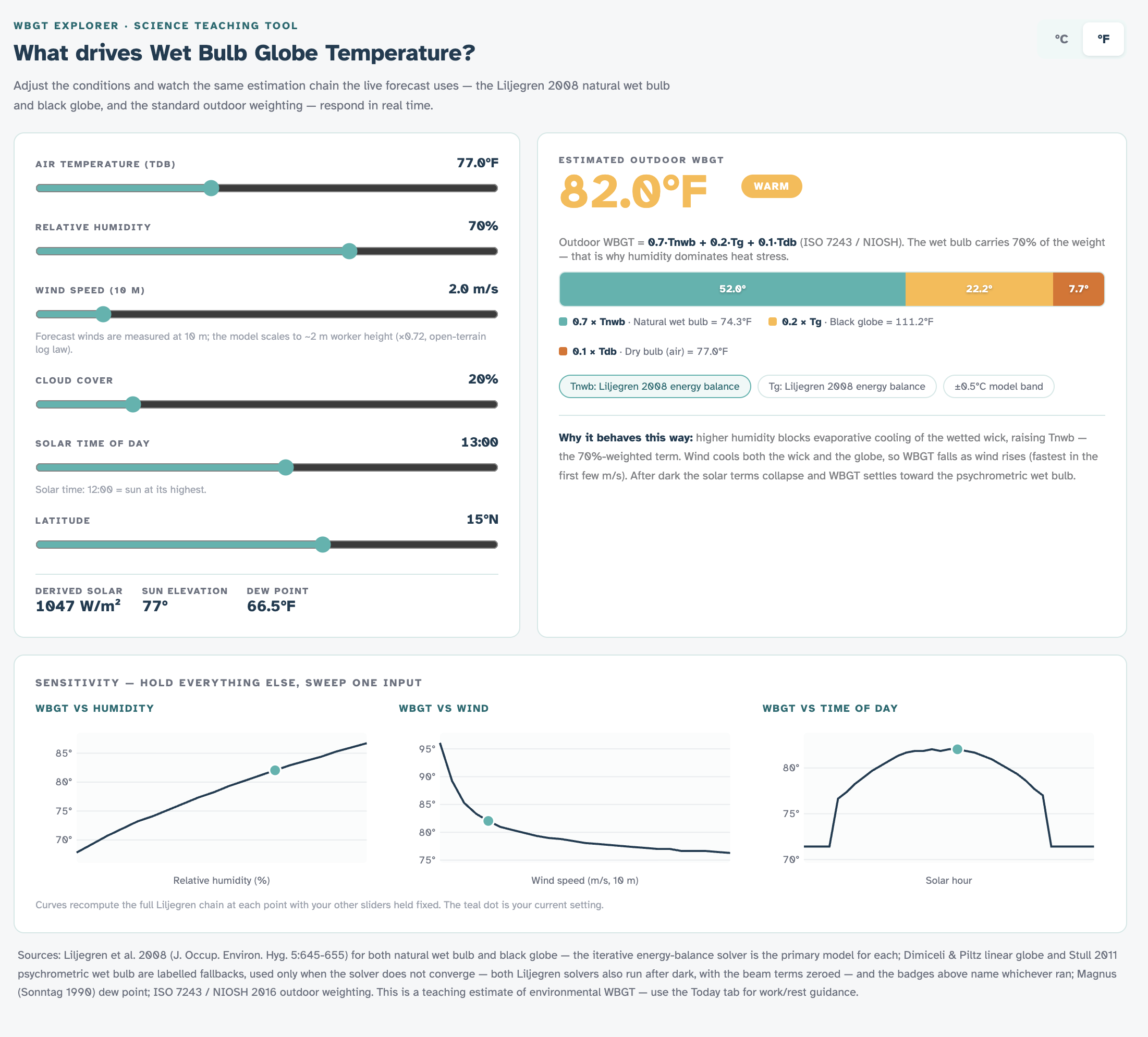
WBGT is a tricky thing to understand, but critical for assessing heat stress, so I created a tool to help visualize how different conditions affect the WBGT reading. You can find it at heatrules.com/#explorer. It shows how temperature, humidity, wind, and solar radiation and even the angle of the sun all combine to create a single number that represents the heat stress on the body.
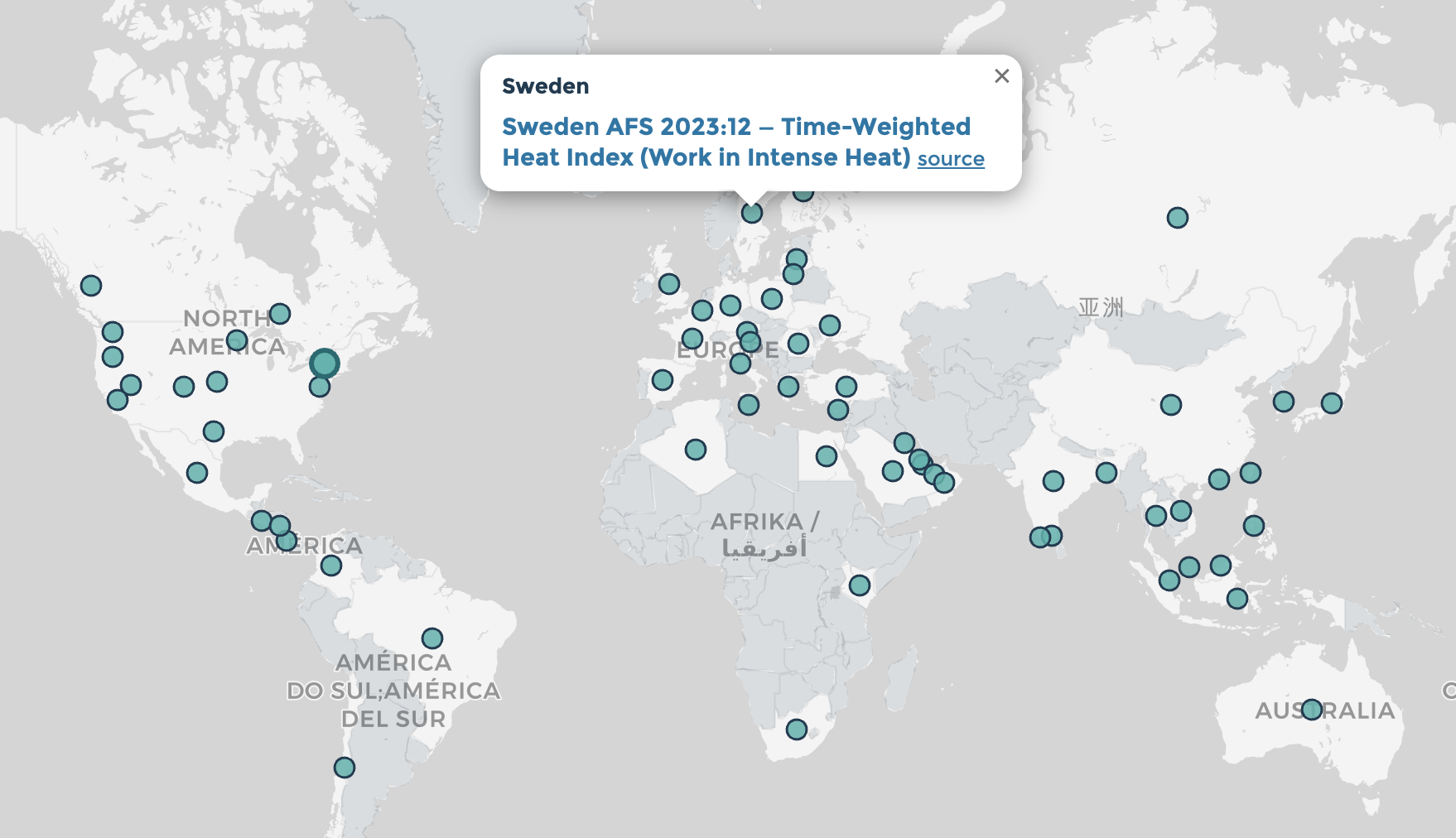
The Map
Once I was able to pull in guidance rules and extract the current legislation from each jurisdiction, I plopped them on a map: